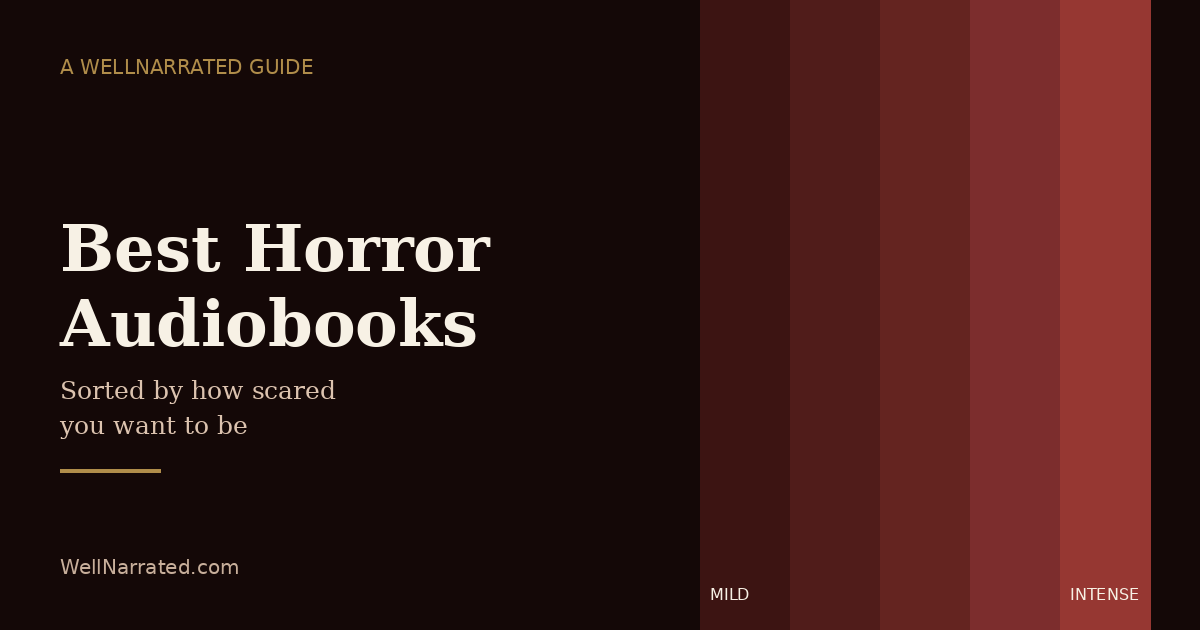
"Horror" covers an enormous amount of ground, a quiet, unsettling children's story and a forty-five-hour epic about a shapeshifting child-killer both technically qualify, and a single ranked list flattens that range into something less useful than it should be. So instead of ranking these seven audiobooks against each other, we sorted them along a spectrum: how scared, specifically, is this book actually trying to make you, and does the narration deliver on that promise.
Level 1: Atmospheric Unease (safe for bedtime, mostly)
Coraline by Neil Gaiman sits at the gentlest end of this list, and it earns its place through atmosphere rather than shock. A girl finds a door to a parallel version of her family, almost right in every way except the button eyes, and Gaiman narrates his own novella with a precise, unhurried restraint that lets the wrongness creep up on you rather than announcing itself. This is horror you could genuinely put on before sleep, assuming you are not specifically unsettled by buttons. Read our full review.
Level 2: Slow-Building Dread (the kind that lingers after)
Dracula by Bram Stoker built the template for gothic dread more than a century ago, and the 2012 Audible Studios full-cast recording, featuring Alan Cumming, Tim Curry, Simon Vance, and Katherine Kellgren among nine narrators, returns the novel to its original epistolary structure of letters and diary entries. The horror here builds patiently across the opening act before the word "vampire" is ever said aloud, closer to a slow tightening than a jump scare. Read our full review.
Feed by Mira Grant approaches dread from an unusual angle: a zombie apocalypse twenty years settled into an uneasy new normal, where the horror comes less from the undead themselves and more from watching institutions and trust slowly erode under sustained pressure. Paula Christensen and Jesse Bernstein's narration keeps that slower-burning political dread grounded rather than tipping into action-horror pacing. Read our full review.
Level 3: Genuinely Unsettling (proceed with a light on)
Warm Bodies by Isaac Marion inverts the zombie genre entirely, narrated from inside a barely verbal corpse's surprisingly rich inner life, and Kevin Kenerly's performance finds real unease in the gap between what the character can express and what he might actually still feel underneath. It is stranger and more tender than straightforwardly scary, but the body-horror premise itself sits at a genuinely unsettling register even when the tone softens. Read our full review.
NOS4A2 by Joe Hill turns the dial up considerably, Kate Mulgrew's narration of Charles Manx, a predator who lures children to a nightmare realm called Christmasland, has been described by listeners as fearless scenery-chewing, gleeful and genuinely unsettling without tipping into cartoon villainy. At nearly twenty hours, this is a sustained, escalating kind of unease rather than a quick scare. Read our full review.
Level 4: Visceral and Heavy (know what you are signing up for)
Joyland by Stephen King is actually the gentlest King title on this list by a wide margin, closer to a melancholic coming-of-age mystery than outright horror, but we place it here rather than higher because King's name alone raises listener expectations that this entry deliberately subverts. Michael Kelly's narration carries real innocence and Southern-inflected warmth, appropriate for material that trades King's usual visceral horror for something quieter and more reflective. Read our full review.
Level 5: The Real Thing (Steven Weber's Pennywise)
It by Stephen King sits alone at the top of this spectrum, nearly forty-five hours spanning two timelines, fourteen character versions, and a shapeshifting entity that speaks in a dozen different registers depending on what fear it is currently wearing. Steven Weber's narration has become a genuine benchmark performance in horror audio, his Pennywise specifically discussed by listeners in the same breath as the character's screen portrayals, which is a rare thing for an audio-only performance to achieve. This is horror asking for real commitment, both in runtime and in what it puts you through. Read our full review.
How to Use This List
If you are horror-curious but easily rattled, start at Level 1 or 2 and see how you feel. If you already know you want genuine dread and have the stomach for it, Levels 4 and 5 deliver on that promise more fully than anything lighter on this list. The mistake we see listeners make most often is picking based on author reputation alone, assuming any Stephen King title will hit the same register, when Joyland and It sit at almost opposite ends of this entire spectrum despite sharing an author.
What Makes Horror Narration Specifically Difficult
Unlike most genres, horror asks a narrator to control pacing with unusual precision, too fast and the dread never has room to build, too slow and tension collapses into tedium rather than suspense. Every narrator on this list who succeeds does so by understanding exactly how long to let silence and restraint do the work before delivering the line that breaks it. Steven Weber's Pennywise, Kate Mulgrew's Manx, and the ensemble cast's handling of Dracula's epistolary dread all share this same underlying discipline, despite sounding nothing alike.
Single Narrator vs. Full Cast: Which Serves Horror Better?
Five of these seven titles use a single narrator; only Dracula uses a full nine-person cast. That split is instructive. Horror often depends on a sustained, controlled intimacy, one voice you trust to guide you through the dark, which is part of why It works as powerfully as it does with Steven Weber alone carrying fourteen character versions and a shapeshifting antagonist across nearly forty-five hours. Dracula is the exception that proves the rule: its epistolary structure, a novel built entirely from different characters' letters and diary entries, genuinely calls for different voices rather than one narrator impersonating several accounts, and the format becomes an asset specifically because the novel was never meant to have a single narrating voice to begin with. For most horror, though, a skilled single narrator sustaining dread across hours tends to outperform a cast, simply because horror's effect depends so heavily on consistency of tone.
Picking Your First Horror Audiobook
If horror audio is new territory for you, resist the instinct to jump straight to the longest or most famous title. Coraline, at under four hours, is the lowest-risk way to find out whether atmospheric horror works for you as a listening experience at all, distinct from how it might land on the page. If that goes well and you want something with real forward momentum, Feed or NOS4A2 offer a middle ground, genuine stakes and dread without the nearly two-day time commitment It represents. Save It itself for when you already know horror audio works for you specifically, since its scale rewards listeners who are already sold on the format rather than convincing skeptics.
A Note on Voice Acting vs. Restraint in Horror
Listeners often assume the best horror narration means the most dramatic performance, big voices, sharp gasps, theatrical menace. The strongest work on this list argues the opposite. Michael Kelly's quiet, innocent delivery in Joyland works precisely because he does not oversell a book that is not trying to be terrifying. George Guidall's measured steadiness elsewhere in genre fiction, and the same instinct visible in Kevin Kenerly's Warm Bodies, comes from trusting the text rather than performing over it. Even Kate Mulgrew's more theatrical NOS4A2, the one performance here that genuinely goes big, stays effective because she commits fully rather than half-performing for safety. The lesson across all seven: horror narration succeeds or fails on judgment, knowing exactly how much a given scene needs, not on a fixed formula of loud versus quiet.
Why We Sorted This Way Instead of Ranking
A flat 1-to-7 ranking would have forced us to compare Coraline against It on the same scale, which misses the point of both books. Coraline is not a lesser version of horror that It does better, it is doing something entirely different, and succeeding at it. Sorting by intensity respects that difference and, we think, actually helps you pick the right book for your specific mood tonight rather than just the highest-rated title on a list.
Frequently Asked Questions
What is the least scary audiobook on this list?
Coraline is the gentlest entry, atmospheric and unsettling rather than graphic, and Joyland is the least horror-focused of the Stephen King titles despite the author's reputation.
What is the scariest and most intense audiobook here?
It, at nearly forty-five hours with Steven Weber's widely acclaimed narration of Pennywise, represents the most sustained and intense horror experience on this list.
Is Dracula still frightening by modern horror standards?
It is more atmospheric and restrained than graphic by contemporary standards, building dread slowly through its epistolary structure rather than through explicit content.
Which horror audiobook has the largest cast of narrators?
Dracula's 2012 Audible Studios recording uses nine narrators for its full-cast epistolary structure, the largest ensemble among the titles on this list.
Browse our full Horror audiobook and ebook reviews for individual, in-depth breakdowns of narration quality, pacing, and how scary each book actually is.