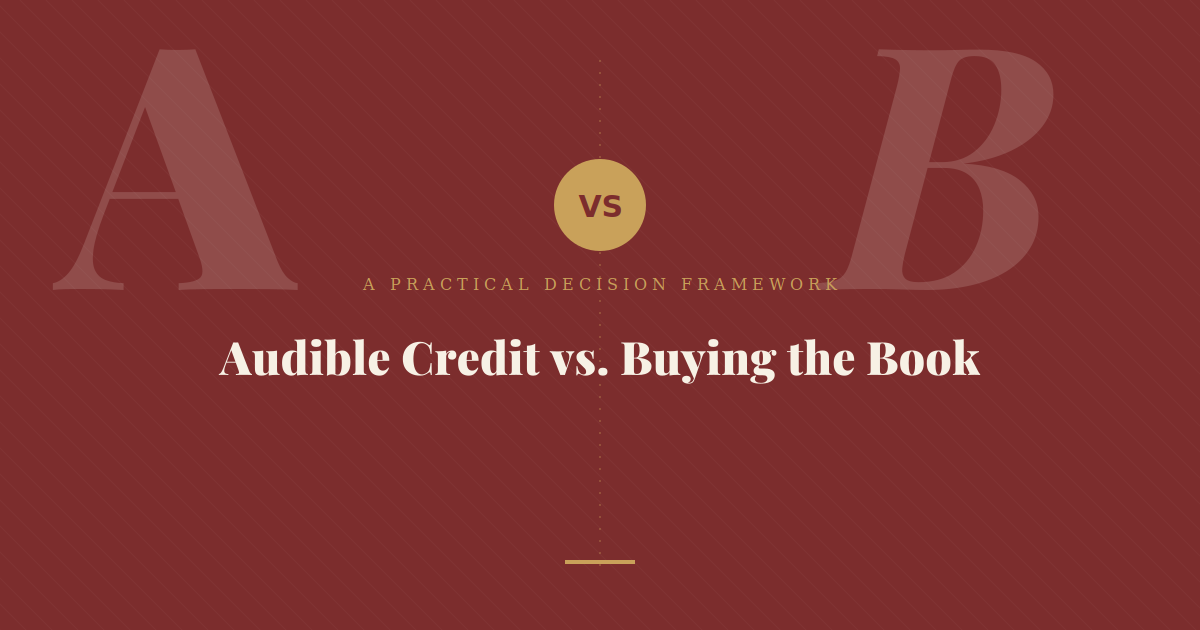
"It depends on the book" is technically true and practically useless. Here is a framework built from reviewing dozens of titles side by side in audio and print, with concrete examples so you can apply it the next time you are staring at a library of unused Audible credits.
Question 1: Does the Book Rely on Visuals?
Charts, diagrams, tables, and reference figures do not survive the jump to audio. Thinking, Fast and Slow includes experiments you are meant to work through on the page; Atomic Habits has habit-tracking scorecards that become spoken lists in audio. Neither book is ruined by audio, but both benefit from having the companion PDF or a print copy within reach. If a book's value is mostly in reference material you will return to, buy it in print or ebook and treat audio as a secondary format at best.
Question 2: Is the Author Also the Narrator?
This is the single biggest variable we check before recommending audio. When it works — Trevor Noah reading Born a Crime in the languages he actually grew up speaking, or James Clear's calm delivery of his own habit framework — the audiobook becomes the definitive edition, arguably better than the page. When an author-narrator is inexperienced or simply flat, the opposite happens. There is no shortcut here: check a sample chapter before buying.
Question 3: Is the Book Argument-Driven or Story-Driven?
Argument-driven non-fiction with clear, numbered structure — Deep Work, The Psychology of Money — tends to translate well to audio because you can follow a spoken argument without seeing it. Story-driven books, especially memoirs like Educated, often work even better in audio than in print, because a skilled narrator adds emotional texture punctuation cannot. The category where audio struggles most is reference-heavy books you expect to revisit and cross-check rather than read start to finish.
Question 4: How Long Is Your Commute or Listening Window?
A fifteen-hour audiobook like Sapiens is a different commitment than a four-hour one like Astrophysics for People in a Hurry. If your only listening time is a twenty-minute commute, a twenty-hour book like Thinking, Fast and Slow will take you a month or more — which is fine if the chapters are self-contained, but frustrating if the book builds a single continuous argument you need to hold in your head.
Question 5: What Does the Math Actually Look Like?
A single Audible credit currently runs close to the cost of one premium audiobook purchased individually, while a used or ebook copy of the same title is frequently cheaper — sometimes significantly. If you listen to one book a month, a credit-based subscription usually wins on cost. If you read in bursts, buying titles individually or borrowing from a library app can be cheaper overall. Track what you actually finish, not what you subscribe to; unused credits are the real hidden cost of any audiobook subscription.
Our Practical Rule of Thumb
Buy audio when: the author narrates their own story, the book is memoir or narrative non-fiction, or you have committed regular listening time (commute, gym, chores) where print is not an option anyway. Buy print or ebook when: the book is reference-heavy, you expect to annotate or revisit specific sections, or the sample chapter's narration does not match the material's tone.
The Cost of Getting This Wrong
The real cost of a mismatched format is rarely the money — it is the abandoned book. A reference-heavy title bought in audio because it was on sale, or a story-driven memoir bought in print because it felt more "serious," both tend to end up unfinished, not because the content was weak but because the format fought the material the whole way through. Unfinished books are the actual waste, and format mismatch is one of the most common, least discussed reasons behind them.
A Worked Example: Two Books, Two Opposite Answers
Take Born a Crime and Thinking, Fast and Slow side by side. Both are excellent, both are widely recommended, and the correct format decision is nearly opposite for each. Noah's memoir is essay-length chapters, driven by voice and code-switching between languages that only exist properly in audio — buying this one in print genuinely loses something the audiobook cannot replace. Kahneman's book is built on small worked examples you may want to pause on, re-read, and compare against your own thinking — a use case print naturally supports and audio actively resists. Neither book is "better" in the abstract; the right format depends entirely on what the book is asking of you as a reader.
Subscriptions vs One-Off Purchases
Beyond the book-by-book decision, it is worth periodically auditing the subscription itself. If your unused credit count is climbing month over month, that is a stronger signal than any individual book decision: the subscription model itself may not fit your reading pace right now, and pausing it for a few months to work through what you already own is often the financially smarter move, regardless of how good the next month's credit deal looks.
A Question We Get Asked Often: What About Library Apps?
Services like Libby and OverDrive complicate this framework in a good way, since they remove the cost question almost entirely for titles your local library carries in audio. If a book you are weighing is available through a library app, the format decision becomes lower-stakes — borrow the audio edition, and if it turns out the material demands print, you have lost nothing but a hold slot rather than a credit. The catch is availability and wait times, which vary enormously by title and region, so this is a supplement to the framework above rather than a replacement for it.
When to Do Both
For genuinely dense titles — Thinking, Fast and Slow is the clearest example on our shelf — many serious readers keep both formats: audio for the commute, print or the companion PDF for the sections that need rereading. It costs more upfront but wastes less time than rewinding audio repeatedly to catch a detail your eyes would have caught instantly on a page. Treat this as the exception rather than the default — reserved for the handful of titles dense enough to genuinely justify owning twice.