 🎧
🎧
History
Sapiens: A Brief History of Humankind
4 reviews
View →

Affiliate link — we may earn a commission at no extra cost to you.
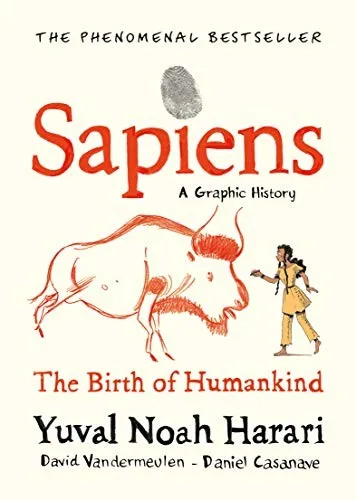
A quick note of clarity before anything else, because this one confuses people: this is a distinct work from the original Sapiens we reviewed. Sapiens: A Graphic History is a reimagining of the first part of Harari's story as an illustrated adventure, and the audio adaptation turns it into a lively, full-cast dramatization rather than a straight reading. If you found the original fifteen-hour Sapiens daunting, this three-and-a-half-hour version is a genuinely different on-ramp, though it comes with a real caveat we will get to.
Harari, with co-writers, recast the opening act of Sapiens, the Cognitive Revolution, the rise of Homo sapiens over other human species, the power of shared fictions, as a graphic novel in which Harari himself is a character, guided through history by a cast of playful figures. The audio adaptation leans into this with a full cast, sound design, and dramatization. It is witty, brisk, and accessible in a way the original is not, and it captures the core "shared fictions" argument, the idea that humans dominate because we can believe in things that exist only in our collective imagination, with real clarity.
The dramatization is well produced and genuinely fun, the voice cast commits, the pacing is quick, and the humor lands. But here is the honest caveat: this is a book that was designed to be seen. The graphic history's whole point is its illustration, and an audio-only version necessarily loses the visual half of the experience. The production works hard to compensate with sound and performance, and largely succeeds at conveying the ideas, but you should know going in that you are getting an adaptation of an adaptation, and that the print or ebook graphic version is arguably the "true" format here. As a companion or an accessible introduction to the ideas, it works; as a replacement for seeing the art, it cannot fully deliver.
Listeners who bounced off the original Sapiens's length or density; younger listeners; anyone wanting a fun refresher on the core argument before or after the main book. If you want the full, serious sweep of human history, the original Sapiens narrated by Derek Perkins remains the essential listen; this is the playful, abbreviated cousin.
Well narrated? The full-cast production is lively and well made, with the caveat that it adapts a visual work into audio. A fun, accessible three-and-a-half-hour entry point to Harari's ideas, best understood as a companion to the original rather than a replacement.
The original Sapiens, for the full, serious, fifteen-hour sweep of the argument this version playfully condenses.
No, it is a distinct, reimagined work covering only the first part of the original, recast as an illustrated adventure with Harari as a character. The audio version is a full-cast dramatization, quite different from Derek Perkins's straight narration of the original.
It depends on your goal. As an accessible, entertaining introduction to Harari's core ideas, yes, the full-cast production conveys the argument well. But since the graphic history was designed to be seen, the audio-only format necessarily loses the visual half; the print or ebook version is arguably the truer format.
For the complete, serious sweep of human history, the original Sapiens is essential. This graphic-history version is best as a fun, brief companion, either an easy entry point before the main book or a playful refresher after it.
About 3 hours 27 minutes, far shorter than the original's roughly fifteen hours, which is part of its appeal as an accessible introduction.
You can hear Sapiens: A Graphic History free with an Audible trial. (Affiliate link, we may earn a commission at no extra cost to you.)
No approved reviews yet. Be the first to write one.